

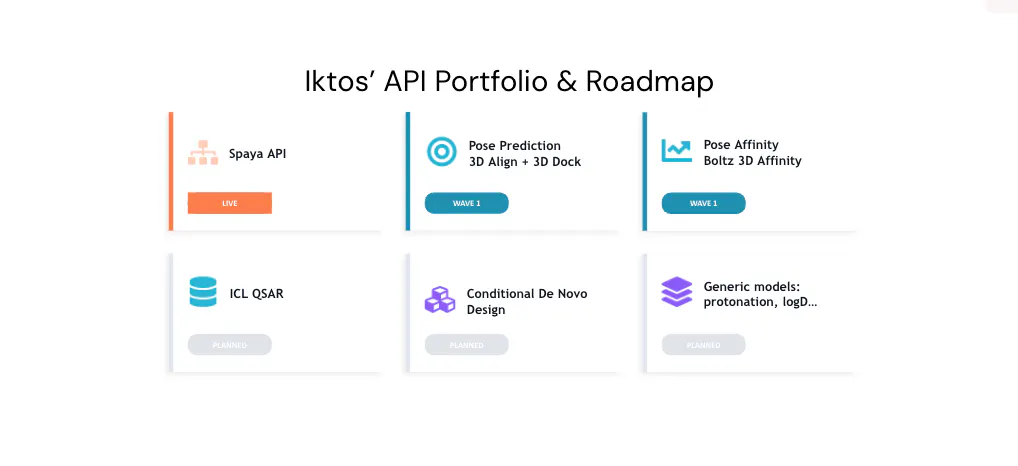
We are excited to announce the introduction of our discovery engine in the form of production-ready APIs for R&D. A series of new APIs will complement our existing predictive retrosynthesis Spaya API, addressing use cases across drug design, QSAR models, and more.
Developed with the aim of supporting the research community in advancing small molecule discovery, the APIs will be released following our testing and validation schedule, in collaboration with selected industry and academia partners.
- Interested in being an early adopter? Join our program, details at the bottom of the page!
Introducing Iktos Engine:
Our first release is composed of 3 high-performance APIs designed to accelerate 3D decision-making across ligand-based and structure-based design, without the cost and complexity of traditional pipelines. The goal is to enable scientists to rank, refine, and prioritize compounds faster.
High Performance, Without the Overhead
- Competitive accuracy across alignment, docking, and affinity benchmarks
- Affinity predictions matching Boltz-2, without protein structure and ligand pose recomputation
- Scalable, low-latency performance suitable for production environments
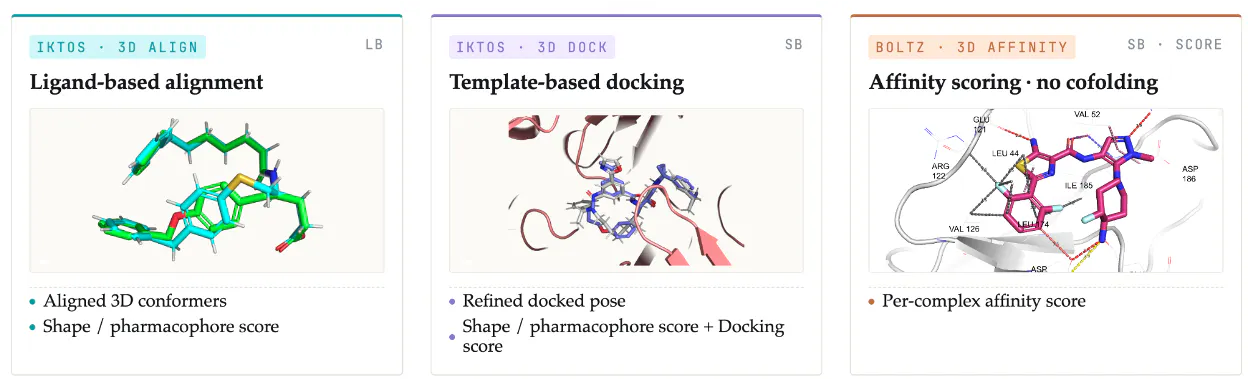
1- Iktos 3D Align: accurate ligand alignment method useful for 3D LB Virtual Screening.
2- Iktos 3D Dock: accurate template-based docking method useful for 3D SB Virtual Screening.
3- Boltz 3D Affinity: reuses the Boltz-2 affinity trunk (Passaro et al. 2025) directly on a user-supplied complex, without the time consuming co-folding.
Iktos Engine: Design logic
3D drug design workflows share three operations that recur at every hit-to-lead optimisation project:
- Pose alignment from a template : align a given query ligand to a known reference ligand.
- Pose prediction in the pocket : produce a physically plausible pose well positioned in the pocket that downstream SB scoring functions can trust.
- Affinity estimation on a trusted complex : once a pose is in hand, estimate binding affinity.
We have integrated these three operations into Iktos Engine as three composable APIs. Each API is scoped to a single operation and exposed as an independent service, letting project teams chain them into the workflow that matches their data. Each API is benchmarked on a public dataset suitable for its task, and each is engineered to meet the latency and budget constraints of real hit-to-lead optimisation projects.
Our key design choices are as follow :
- Iktos 3D Align : expert rather than neural, by design. Iktos team previously introduced the FMA-PO alignment framework in Bergues et al. (2025), achieving state of the art performance in molecular alignment and template-based docking. Iktos 3D Align is inspired by FMA-PO, retaining the Pose Optimisation (PO) part but replacing the neural pre-alignment step with a computational chemistry expert protocol based on common substructure matching. The goal is not an incremental gain in precision, but scalability and efficiency.
- Iktos 3D Dock : pocket-aware version of Iktos 3D Align. Iktos 3D Dock extends Iktos 3D Align by bringing the protein pocket into the loop: we augment the pose-optimisation (PO) objective of FMA-PO with a Vina scoring term and a soft-clash term, so that the optimised pose is not only consistent with the reference ligand but also physically plausible inside the pocket.
- Boltz 3D Affinity : Boltz-2 affinity trunk with no co-folding. We extract the Boltz-2 affinity head and serve it directly on user-supplied 3D complexes. This variant is not available in the upstream Boltz public repository. It removes the co-folding stage which is redundant whenever the user already trusts the input structure, leaving a pure affinity scorer that runs several times faster than the full co-folding pipeline.
Iktos 3D Align and Iktos 3D Dock are template-driven by design: they extract maximum signal from a known reference (an active molecule or a co-crystallised ligand) to constrain the 3D placement and refinement of every new candidate, which is the dominant operating regime in hit-to-lead optimisation.
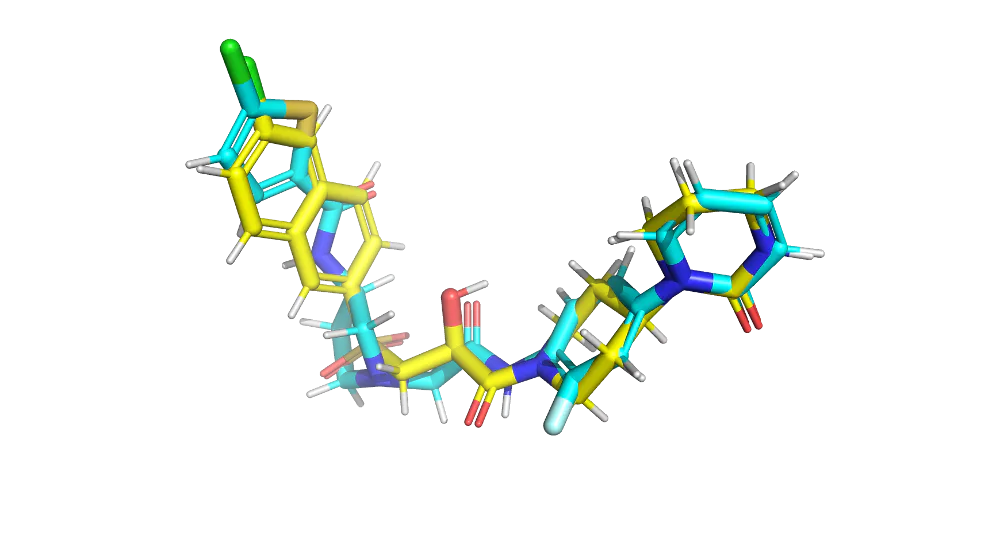
Figure 1: Iktos 3D Align pose prediction for PDB entry 2VVU (in cyan) using the ligand from PDB entry 3KL6 as template (in yellow)
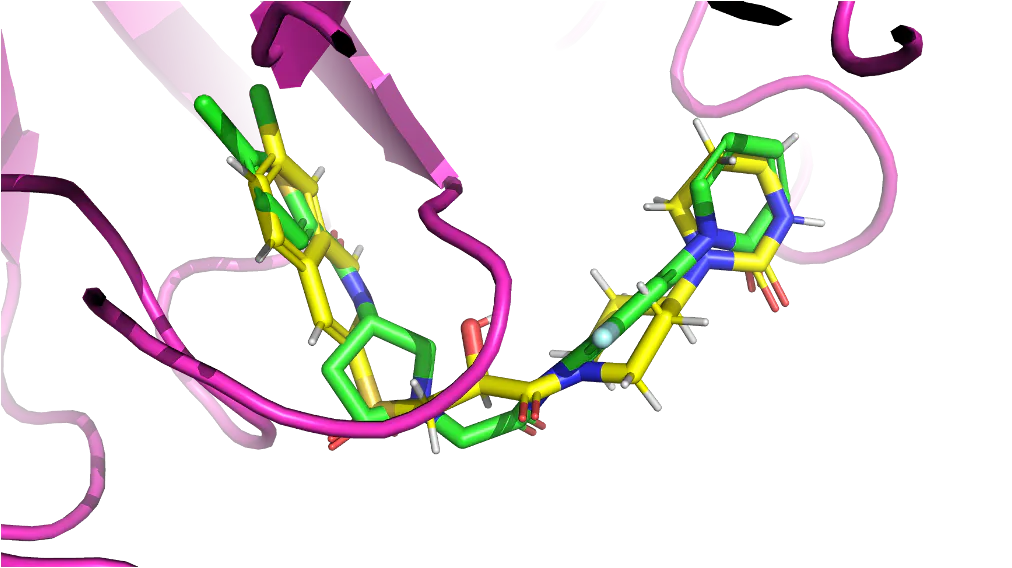
Figure 2 : Iktos 3D Dock pose prediction for PDB entry 2VVU (in green) using pocket and ligand from PDB entry 3KL6 as template (in magenta and yellow).
Technical Report Highlights
We present below key benchmark data for each API with selected examples of integrating them into a complete end-to-end workflow. For further details, please refer to the Technical Report linked below.
We evaluate Iktos 3D Align on AlignDockBench (Bergues et al. 2025): 369 cross-docking pairs distributed over 61 anchor co-crystal complexes. For each pair, the reference and target pockets are aligned. Performance is reported as heavy-atom RMSD to the true co-crystal pose of the target ligand.

Table 1: Performance comparison of Iktos 3D Align and ligand-based methods on AlignDockBench.
Iktos 3D Align consistently outperforms ligand-based open source baselines across all RMSD thresholds (66.1% below 2 Å vs 48.5% and 54.2%), indicating higher accuracy in recovering near-native poses.
On the same 369 AlignDockBench cross-docking pairs, Iktos 3D Dock shows performance very similar to Iktos 3D Align confirming that both approaches achieve comparable accuracy. They consistently outperform classical structure-based baselines such as FitDock, Autodock Vina and rDock, although they remain below FMA-PO, which achieve the best overall results.
Importantly, Iktos 3D Dock and Align remain competitive while running on CPU, in contrast to FMA-PO methods that require GPU, highlighting a favorable trade-off between performance and computational cost.
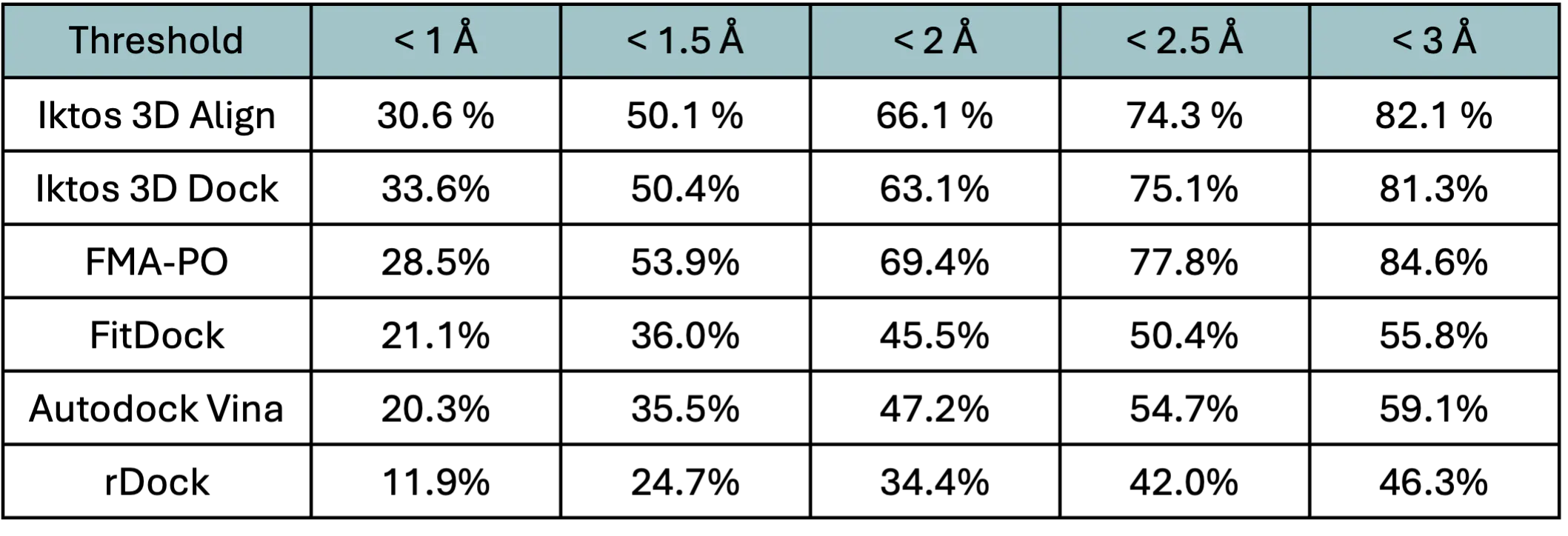
Table 2: Performance comparison of Iktos 3D APIs and structure-based methods on AlignDockBench.
Iktos 3D Dock shows a substantial improvement in the overall PB-valid rate compared to Iktos 3D Align, increasing from 43.4% to 75.9% (+32.5 percentage points) (Figure 2). This gain is primarily driven by pocket-aware constraints: the pass rate for minimum distance to the protein rises from 44.4% to 90.2% (+45.8 pts), while the volume overlap criterion reaches near-saturation at 99.7% (+13.6 pts). The gain in PB-validity justifies the additional runtime in a structure-based setting for Iktos 3D Dock compared to Iktos 3D Align, as it produces physically consistent, pocket-aware poses.
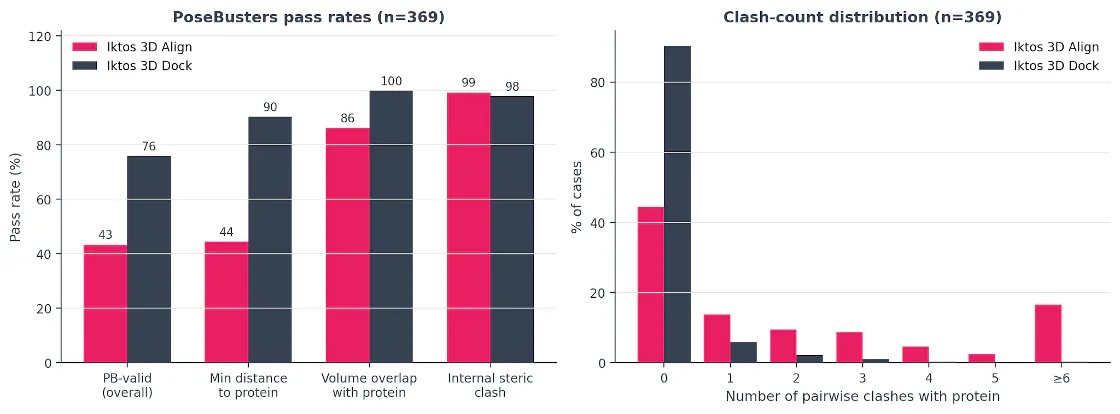
Figure 2 | PoseBusters validity on AlignDockBench (n=369). Left: pass rates on four PoseBusters criteria for Iktos 3D Align (magenta) and Iktos 3D Dock (grey). Right: distribution of the number of pairwise clashes with the protein.
Co-folding-free ≈ co-folding: the core operational claim
Figure 3 shows that the co-folding-free Boltz 3D Affinity is statistically indistinguishable from Boltz-2 in its default co-folding mode on OpenFe/FEP+ benchmark; the difference between the two means is well within the per-run standard deviation.
In other words, once a reliable 3D complex is available (e.g. from an accurate template based docking method like Iktos 3D Dock), co-folding provides negligible improvement to affinity prediction while still imposing a substantial computational cost, which is exactly the kind of overhead production workflows seek to eliminate.
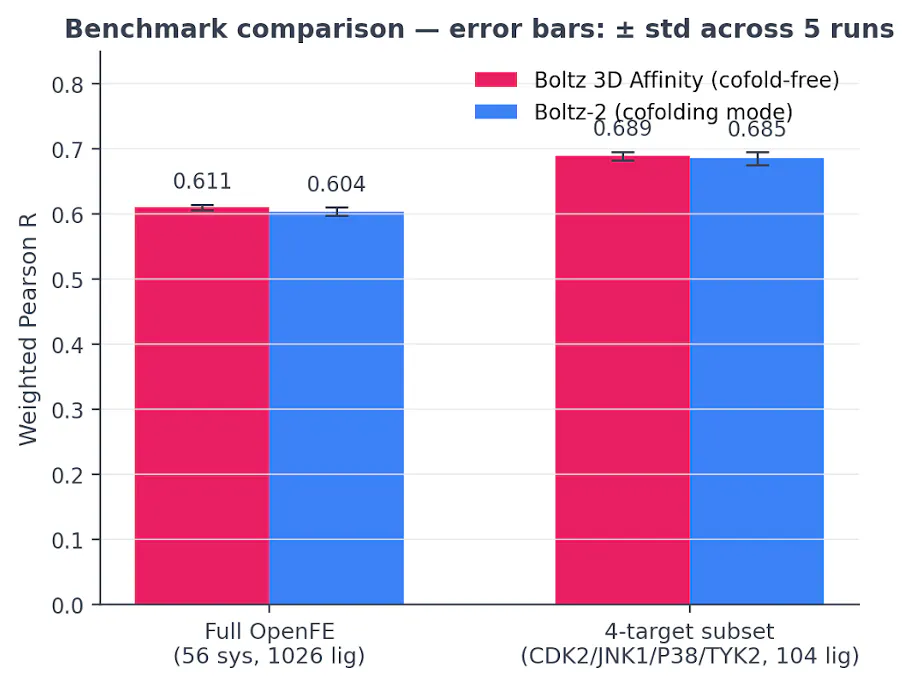
Figure 3 | Co-folding-free Boltz 3D Affinity vs Boltz-2 co-folding mode. Benchmark summary showing the weighted Pearson correlation for the co-folding-free Boltz 3D Affinity and Boltz-2 co-folding mode on the full FEP+/OpenFE benchmark and on the 4-target subset.
Project leader: