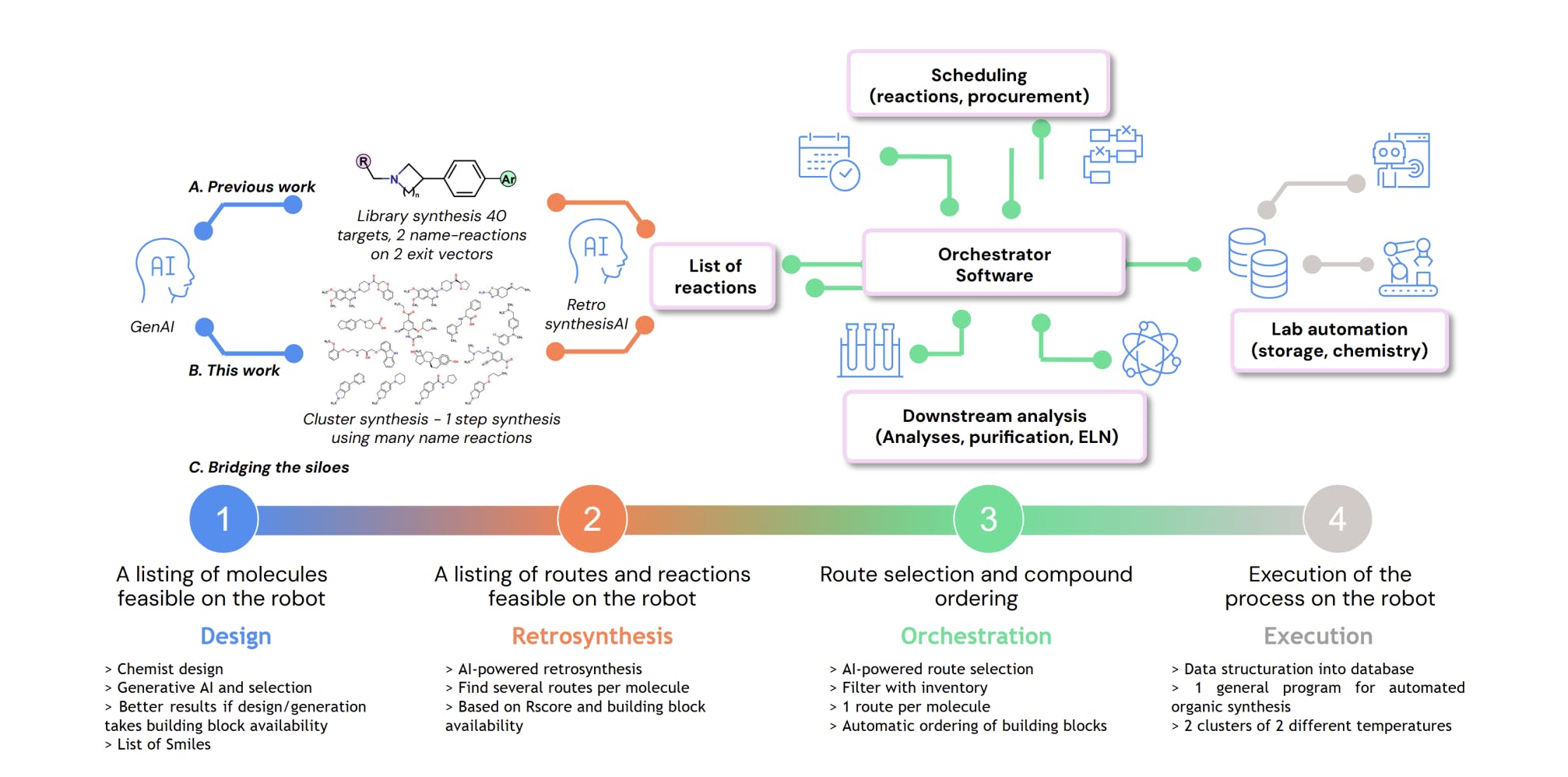
This RSC paper from the Iktos team introduces a paradigm shift in automated chemistry. Instead of synthesizing traditional mono-reaction libraries, the Iktos team developed a method to cluster multiple reaction types based on compatible conditions, allowing the synthesis of 135 structurally diverse molecules using 27 different name reactions in only three campaigns.
Powered by Iktos’ AI-driven tools Makya and Spaya and orchestrated by the Ilaka software, this fully integrated robotic platform demonstrates how AI and automation can merge to accelerate high-diversity chemical synthesis and transform drug discovery workflows.
Follow the link to read the full publication.
ABSTRACT
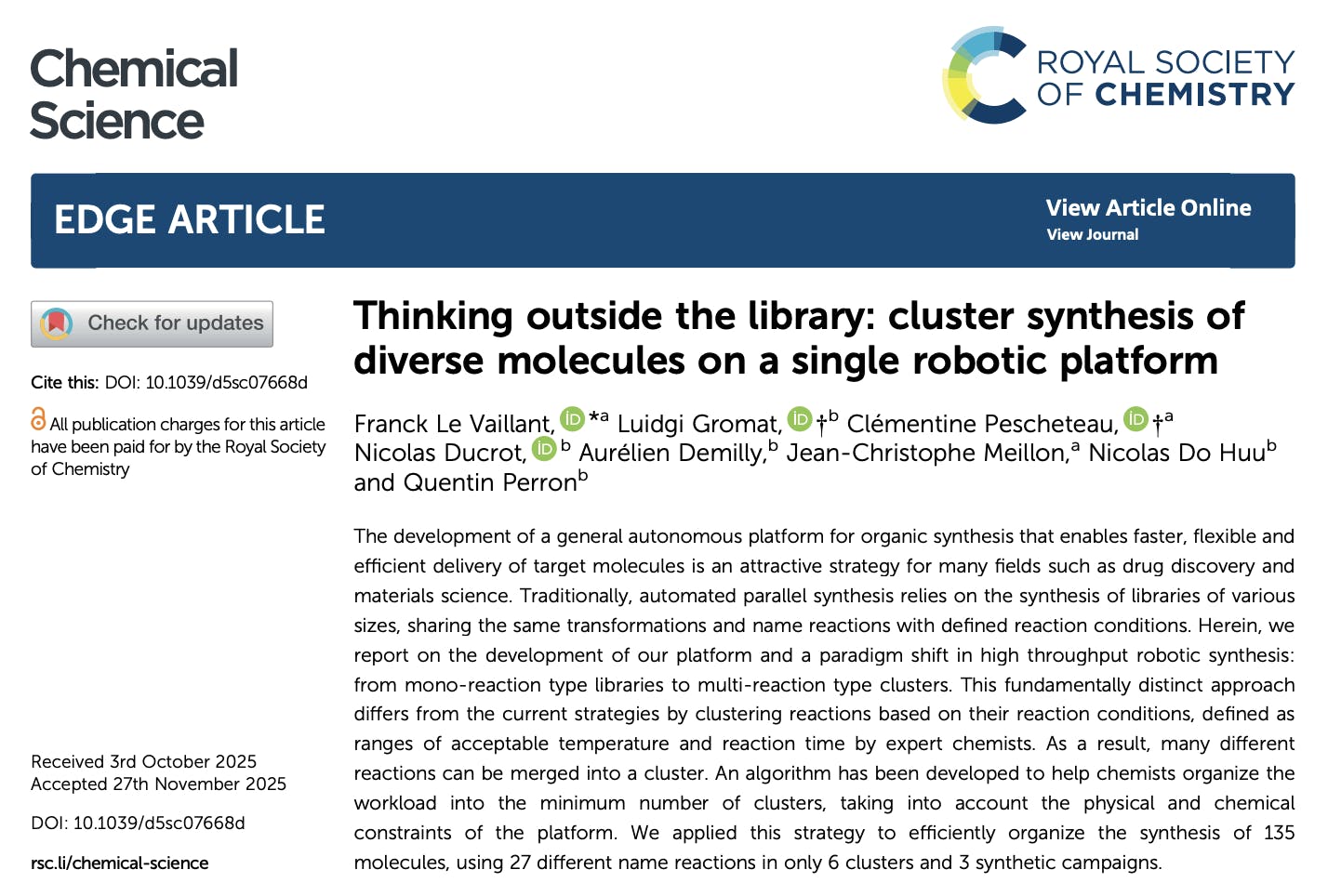
The development of a general autonomous platform for organic synthesis that enables faster, flexible and efficient delivery of target molecules is an attractive strategy for many fields such as drug discovery and materials science. Traditionally, automated parallel synthesis relies on the synthesis of libraries of various sizes, sharing the same transformations and name reactions with defined reaction conditions. Herein, we report on the development of our platform and a paradigm shift in high throughput robotic synthesis: from mono-reaction type libraries to multi-reaction type clusters. This fundamentally distinct approach differs from the current strategies by clustering reactions based on their reaction conditions, defined as ranges of acceptable temperature and reaction time by expert chemists. As a result, many different reactions can be merged into a cluster. An algorithm has been developed to help chemists organize the workload into the minimum number of clusters, taking into account the physical and chemical constraints of the platform. We applied this strategy to efficiently organize the synthesis of 135 molecules, using 27 different name reactions in only 6 clusters and 3 synthetic campaigns.