Access to webinar recording here
Agenda Highlights
Join us for a webinar co-organized with Chemspeed, a Swiss leader in laboratory automation systems.
In this session, we will explore how the integration of AI and robotics can address key bottlenecks in drug discovery—enabling a faster, more seamless transition from in silico ideation to in vitro validation.
While AI and automation are increasingly adopted, many organizations still face fragmented workflows and limited scalability. We will discuss how a coordinated approach—bringing together human expertise, AI, and advanced hardware—can unlock meaningful productivity gains and improve the efficiency of the DMTA cycle.
What you will learn:
- The limitations of siloed automation and overly rigid systems
- How to effectively orchestrate AI, robotics, and human expertise
- How Iktos’ AI-driven orchestration technology (Ilaka) connects design to execution
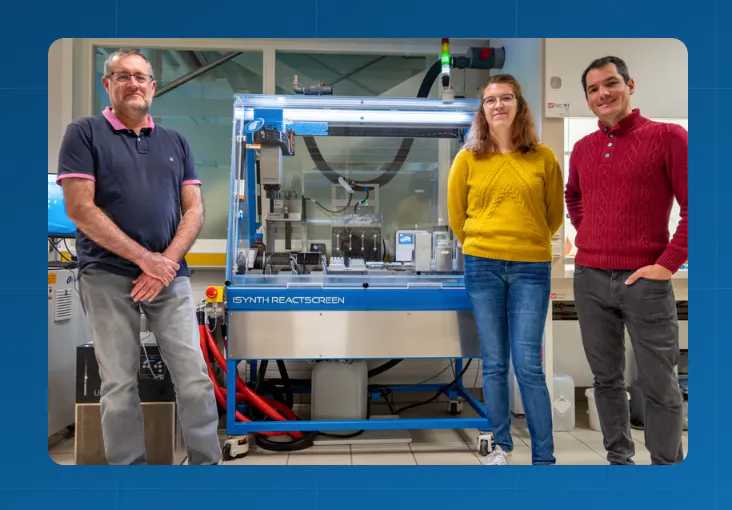
- The benefits of combining Iktos software with Chemspeed robotic platforms
Highlights:
- From virtual molecules to executable synthesis workflows
- AI-driven retrosynthesis, reagent sourcing, and scheduling
- Scaling synthesis complexity with reaction clustering
- Real-world perspectives on implementing autonomous workflows
Together with Chemspeed, we are enabling a new era of AI-driven laboratory automation—bringing the power of autonomous workflows to a broader range of research teams. Our AI-driven orchestration platform is now made available to drug discovery partners via technology transfer, supporting the deployment of fully connected, end-to-end synthesis workflows.
We look forward to welcoming you and sharing how AI-driven laboratory automation is shaping the future of chemical discovery.
Speaker
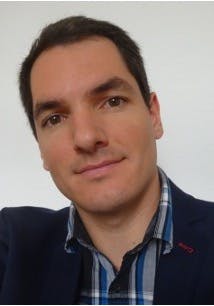
Franck Le Vaillant
Senior Scientist - Deputy Lab Head
Franck has a Master degree from the Ecole Nationale Supérieure de Chimie de Montpellier. From 2014 to 2018, he carried out his PhD studies at EPFL under the supervision of Prof. Jérôme Waser, during which he explored photoredox-catalyzed functionalizations of radicals using hypervalent iodine reagents. He then moved as SNF-postdoctoral fellow in the group of Dr Josep Cornella at the Max-Planck-Institute für Kohlenforschung in Mülheim an der Ruhr, where he developed Ni-catalyzed C-O bond formations using nitrous oxide. He came back to France to start the Labcom HitCat, a joint lab between the company Seqens and the group of Prof. Géraldine Masson (CNRS). Since July 2022, he has joined Iktos as Senior Scientist – Deputy Lab Head, where he works on the installation, development and utilization of the Iktos Robotics Platform for AI-driven Drug Discovery.
This webinar will cover research topics and results that are part of the recently awarded European Innovation Council (EIC) grant, supporting our continued efforts to advance and scale our robotics platform.